

Issue 221
C&T Round Up for April 2023!

This month, we talked about analyzing qPCR results, Phage Australia's official response to the Phage UK inquiry, and got hands on with building a project with ChatGPT!

Community digest2alerts5updates3jobs3posts
Phage alert
Urgent need for Mycobacterium abscessus phages for patient in Singapore
We are urgently seeking Mycobacterium abscessus phages for patient in Singapore.
Ways to help at this stage:
- By sending your phages for testing on the patient's strains
- By receiving one or more of the patient's strains and testing your phages
- By receiving the strain(s) and using it/them to search for new phages
- By offering to prepare phages supplied by others to clinical grade
- By helping spread the word about this request
- By providing us with names/email addresses of labs you think we should contact
Please email staff@phage.directory if you can help in any way, or if you would like further details/clarification.
Let’s make a difference, Phage Directory
Urgent need for Haemophilus influenzae phages for patient in Switzerland
We are urgently seeking Haemophilus influenzae phages for patient in Switzerland
Ways to help at this stage:
- By sending your phages for testing on the patient's strains
- By receiving one or more of the patient's strains and testing your phages
- By receiving the strain(s) and using it/them to search for new phages
- By offering to prepare phages supplied by others to clinical grade
- By helping spread the word about this request
- By providing us with names/email addresses of labs you think we should contact
Please email staff@phage.directory if you can help in any way, or if you would like further details/clarification.
Let’s make a difference, Phage Directory
Updates
The Israeli Phage Therapy Center (IPTC) has received 159 requests for phage therapy, with 38% of them being for multi-drug resistant bacteria. Respiratory and bone infections were the most prevalent indications. 20 phage therapy courses were given to 18 patients, with a favorable clinical outcome seen in 77.7% of the cases.
In this preprint, Xin Tan and colleagues show that repeated doses of phage lead to faster phage clearance in rats and monkeys. The study found that while plasma phage titer gradually decreased over time following a single dose, repeated doses caused it to drop 2-3 logs compared to the first dose regardless of phage type.
Acne treatments often require extended periods and can be expensive, leading to the exploration of phages as an alternative. This study by Daniela Torres Di Bello and colleagues found that Pa.7 phage encapsulated in liposomes is not cytotoxic for HaCaT cells and can be safely used for skin treatments.
Jody McKerral and colleagues analyzed >2.5 million prophages from >500,000 bacterial genome assemblies, revealing that 94% are lysogens containing at least one identifiable prophage. The findings provide a new framework for identifying phages in environmental datasets, diverse bacterial phyla, and different locations.
In this review, Juan Carlos García-Cruz and colleagues discuss multiple potential applications for phages beyond classical phage therapy, including cattle raising, agriculture, pest control, microbiome modulation, and disinfection.
Jobs
Dr. Andrea Fossati recently joined as an assistant professor in Karolinska Institute where he will explore the Mycobacterium immune system to understand molecular determinants for successful phage infection. Interested candidates may contact him about upcoming oppurtunities in his lab.
The School of Plant Sciences in the University of Arizona is seeking a research technician with experience in single-stranded DNA virus assembly and packaging. The responsibilities include developing protocols, performing experiments, and lab maintenance.
University of Leicester is seeking a PhD student to test the host range and properties of existing mycobacterial phages and isolate new phages against M. tuberculosis and non-tuberculous mycobacteria (NTMs, such as Mycobacterium abscessus) that circulate in UK hospitals.
Community board
The UK Phage Innovation Showcase will take place May 16th, 2023 from 9:30am-4pm in Leicester and online. The event is organized by Innovate UK KTN's Phage Innovation Network and the University of Leicester's recently launched Centre for Phage Research. This event celebrates its launch and showcases the knowledge and experience in phage research and development in the UK.
All in-person spaces have now been filled, but you can still sign up to watch the livestream of the keynote speeches and Q&A sessions on the day.
The European Medicines Agency (EMA) is organizing a Focus Group meeting on 11 May 2023 to discuss the draft guideline on the quality, safety, and efficacy requirements for bacteriophage therapy in veterinary medicines. The aim is to establish a suitable regulatory framework for these innovative therapies and reduce the use of antibiotics.
In this podcast, Dr. Jeremy Barr from Monash University and Phage Australia talks about his research on using phages to restore antimicrobial sensitivity in Acinetobacter baumannii.
We put out some good work in April! This month we’ve been neck deep in doing qPCR (Jess) and building lots of AI-powered tools for the lab (Jan and Jess). This month we’ve been thinking hard about the data-side of phages, as AI tools have all of a sudden become much friendlier to use and work with.
We also learned a new term this month: “humid lab”: a combination of “wet lab” and “dry lab” research. Basically it means scientists who know their way around the bench AND slinging code. Though I think I can help Jess get better at coding… I don’t think I’ll ever be good at stepping foot in the lab. I’ll probably spill stuff everywhere… and emphasizing the “wet” of wet lab.
The only thing that's wet this month is Sydney's weather (it's cold and rainy again...), so we've been hacking away at our computers! Here’s what we wrote for April:
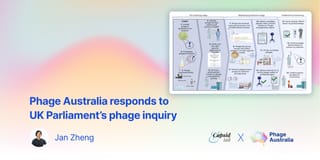
This is a summary of Phage Australia’s official response, in the form of a white paper, to the UK Parliament's Science and Technology Committee inquiry on the "antimicrobial potential" of using phages. The paper discusses the strengths of bacteriophages, including their specificity and continued activity in the face of antibiotic resistance, and the challenges, including uncertainty in applying phages in therapy, regulatory frameworks, and lack of IP protection. It also touches on regulatory clarity, the need for surveillance programs, a tiered approach to working cell banks, and GMP pathways to develop an economically viable model for phage therapy.

In this post, Jess talks about her journey (thanks to my constant prodding) from going from 0→1 in building a fully function chat bot for Capsid & Tail (which you can try out at our labspace.ai experiment). Jess talks about using a combination of tutorials and ChatGPT to overcome obstacles and errors and eventually write the code for a fully-functioning chat bot! She outlines every step it took to ask me, ChatGPT, and use online resources to learn coding and build cool projects. She makes the case that coding isn’t just for coders — and that anyone can build useful tools with the right resources and support!

C&T Throwback!
Now that we’re fully on the Generative AI bandwagon, we’re keen on reading up on anything related to phages, microbes, and bioinformatics data. I’m revisiting this article, “Illuminating one of biology’s biggest blind spots” by Kayla Young from Phase Genomics. In this article, Kayla tells us about building a comprenehsive phage-bacteria “interactome atlas” using something called proximity ligation-based metagenomic sequencing. Read our post or jump straight to their Nature paper: https://www.nature.com/articles/s41587-021-01130-z (Open access here: https://library.wur.nl/WebQuery/wurpubs/fulltext/562048)
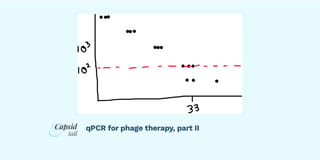
In this post, Jessica wraps up her series on doing qPCR for phage therapy (read part 1 here). In this followup, she explains how to interpret qPCR results when using it to quantify phages or bacteria in patient serum samples. She talks about the importance of analyzing standard and melt curves, how to look at negative controls, and how to think about Cq values. She wraps up the post by noting that qPCR can only detect DNA copies and can’t differentiate between living and dead phages or bacteria.