

Issue 258
C&T Round Up for March 2024!

Round up time! This month we did our first 'Phage Picks' issue, dove into how prophages impact fly sperm, shared insights and recordings from Urmi's webinar series with top phage therapy clinicians, and Elisabet More from PDB Biotech taught us about phage diagnostics.

Community digest5updates3jobs3posts
Updates
NexaBiome (previously FixedPhage) has partnered with JAFRAL to ramp up development (a hundredfold increase!) of their industrial-scale production of immobilized phage. This is part of NexaBiome's strategy to expand deeper into the human health sector.
Danica Schmidtke (Stanford University) and colleagues published a new preprint on how the prototypic crAssphage demonstrates a phage-plasmid lifestyle, persisting extrachromosomally without integrating into the host’s chromosome.
Fan Yang (University of Texas, Tyler School of Medicine) and colleagues published a new paper on phage therapy for the treatment of M. tuberculosis infections in humanized mice. They saw that mice infected with aerosolized TB then treated with DS6A phage intravenously showed increased body weight and improved pulmonary function relative to control mice.
Ruo Han Wang (City University of Hong Kong) and colleagues published a paper on PhageScope: a new online phage database with comprehensive annotations comprising 873,718 phage sequences. It provides annotations on genome completeness, host range, lifestyle, taxonomy, and more, and also incorporates automatic analyses and visualizations.
Paul Turner (Yale University) and colleagues have written a new review on gaps in modern phage therapy R&D. It includes some fun exploration of how AI & synbio could ease phage therapy logistics, a walkthrough of how and why new funding & regulatory models would help, an overview of how local phage centers and small biotechs are pushing phage therapy forward in the absence of large pharma, and more. Great read!
Jobs
Imperial College London is hiring a Research Associate for a project led by Prof. José R Penadés to investigate lateral transduction in phages, exploring its prevalence in nature and impact on bacterial evolution, particularly regarding antimicrobial resistance and virulence.
Ecole Normale Supérieure, Paris, France, is hiring a postdoc to model the ecological and evolutionary impacts of horizontal gene transfer and phage infections in microbial communities, integrating biophysics, ecology, and statistical physics.
University of Exeter is hiring a Research Technician to support the work of the Westra and van Houte research teams on the development of synthetic phage therapy.
Community board
Aaryan Harshith (Stanford University) has just launched PhageBase, a dedicated phage TEM image database. There are already quite a few phages on there; feel free to upload your own! He wrote a blog introducing it here.
Phage researchers are invited to save the date for the 2024 International Soil Virus Conference in Livermore, California, USA, from June 25 to June 27, focusing on exploring the multifaceted roles of soil viruses within a One Health framework and featuring speakers such as Dr. Kurt Williamson and Dr. Uri Neri. Contact organizer Gary Trubl for more info.
New phage textbook edition alert! Tristan Ferry, an ID physician in Lyon, announced the release of the second edition of "Bacteriophage Therapy; From Lab to Clinical Practice.". The book, edited by Sanna Sillankorva and Joana Azeredo, covers advanced experimental and clinical phage therapy methods.
Hello from rainy San Francisco!
We moved here about a month ago and are slowly settling in. We lucked out and are actually house-sitting for Tobi Nagel, who runs Phages for Global Health. She’s currently in Africa as part of her Fulbright Fellowship program!
We’re meeting a ton of people who do biology, machine learning, biotech, and “techbio.” It’s exciting! And really fun! But it wears you out if you go to every single one of them. (I’m actually skipping a meetup to write this…).
As we’re settling into the SF-biotech lifestyle, we’re also settling back into our regular cadence of Capsid & Tail posts, and we’re ready to hear what you’re working on!
If you’d like to share a bit about your research on Capsid, consider writing for us!
Without further ado, here’s what we covered in March.
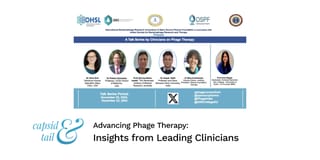
In this blog post, Urmi Bajpai, Ankush Gupta, and Shivani Bharadwaj summarize a series of talks organized by the International Bacteriophage Research Consortium (IBRC) & Open Source Pharma Foundation (OSPF) in association with the Indian Society for Bacteriophage Research and Therapy (SBRT) during World Antibiotic Awareness Week 2023. The talks featured leading clinicians from the United States, Australia, India, and Georgia who shared their experiences and insights on phage therapy. The discussions covered various topics, including phage sourcing, preparation, delivery routes, dosing, patient response, genetically engineered phages, and clinical trials. The post highlights the importance of standardized protocols, phage banks, and carefully structured clinical trials for the advancement of phage therapy. Despite the challenges, the clinicians expressed optimism about phage therapy as a potential solution to the antibiotic resistance crisis.
In this blog post, Jessica Sacher discusses a recent paper by Rupinder Kaur and colleagues, which shows how a prophage controls fly reproduction. The researchers found that specific nucleases encoded by a prophage living within a symbiotic bacterium (Wolbachia) inside the fruit fly (Drosophila) act as a switch that determines whether a new fly embryo lives or dies. The prophage proteins, CifA and CifB, degrade Drosophila sperm DNA and RNA, impairing the histone-to-protamine transition essential for successful fertilization. This leads to DNA damage in embryos and altered sperm development, ultimately causing embryos to die. Jessica highlights the significance of this discovery, as it demonstrates that phage proteins can enter the eukaryotic nucleus and perform important life-or-death functions in animals. She also raises questions about the potential implications for phage therapy and applications, as well as the broader context of biocontrol and insect population control.

In the first post of the month, we introduced a new format. We wanted to try to surface some of our favorite, “stickiest” papers that we love to revisit, or have a copy lying around our hard drives for quick reference. If you have a paper you come back to time and time again, please share it with us, and tell us why you love it!
- "Rapid assessment of changes in phage bioactivity using dynamic light scattering" by Tejas Dharmaraj et al. (https://doi.org/10.1093/pnasnexus/pgad406). The authors demonstrate how Dynamic Light Scattering (DLS) can be used as a quick, reliable, and non-destructive method to measure phage stability, reducing the need for time-consuming plaque assays.
- "Large language models improve annotation of prokaryotic viral proteins" by Flamholz et al. (https://doi.org/10.1038/s41564-023-01584-8). This paper shows how protein language models (PLMs) can improve the annotation of proteins compared to traditional methods, potentially leading to the discovery of new integrases, capsid proteins, and research areas. The code and data are available on GitHub for reproducibility.
In this guest post, Elisabet provides an overview of phage-based diagnostics, highlighting their advantages such as rapid detection, specificity, and cost-effectiveness. She explains various methods like phage amplification assays, phage display technology, and phage-induced bacterial lysis. Elisabet also details the process of producing phages for diagnostics, including phage-induced lysate, purification, storage, and transport. She presents a case study on the use of Actiphage TB for detecting viable Mycobacterium tuberculosis and discusses advancements and future directions in this field, such as the potential for assessing antibiotic resistance in bacterial strains.